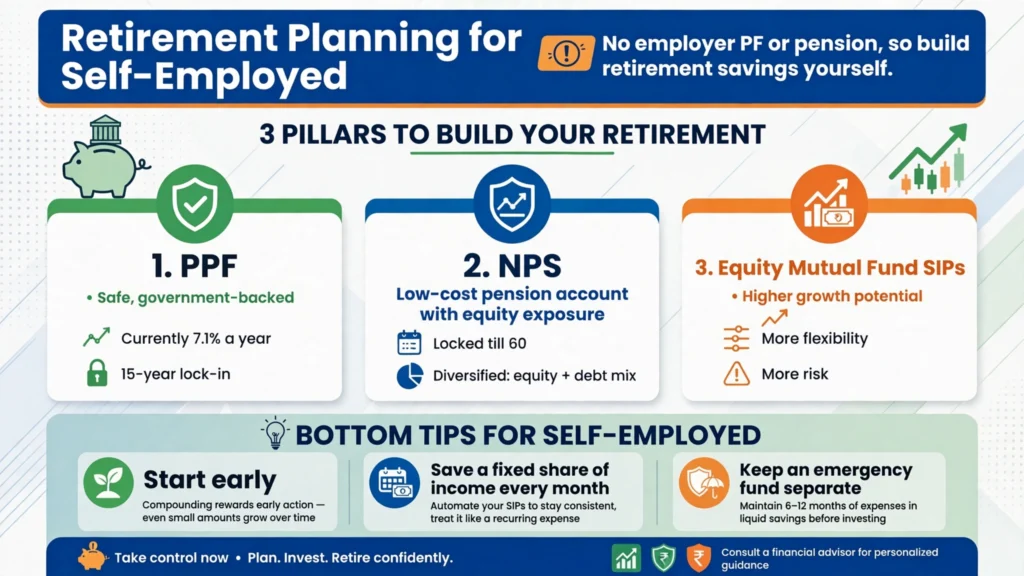
Retirement Planning for the Self-Employed: NPS, PPF and Mutual Funds Compared
Why retirement planning is harder for the self-employed
- No automatic deductions: salaried people have PF deducted every month; you must do it yourself
- Irregular income: some months are good, some aren’t
- Business and personal money mixed: retirement savings get used for business needs
- No employer pension or gratuity
The fix: treat retirement saving like a fixed monthly bill. First, see our guide on separating personal and business finances.
Option 1: PPF (Public Provident Fund)
| Feature | Details |
| Interest | 7.1% a year (rate for October–December 2026, reviewed every quarter) |
| Safety | Government-backed |
| Lock-in | 15 years (extendable in 5-year blocks); partial withdrawals allowed after a few years |
| Investment limit | ₹500 to ₹1.5 lakh a year |
| Tax | Interest and maturity are tax-free; deduction on investment under the old tax regime |
Good for: the safe, guaranteed part of your retirement savings.
Option 2: NPS (National Pension System)
| Feature | Details |
| Returns | Market-linked; you choose a mix of equity, corporate bonds and government bonds |
| Cost | Very low fund management charges |
| Lock-in | Till age 60 for Tier I (limited partial withdrawals allowed) |
| Minimum | ₹500 per contribution; ₹1,000 a year for Tier I |
| Tax (old regime) | Deduction up to 20% of gross income under 80CCD(1), within the ₹1.5 lakh overall limit, plus an extra ₹50,000 under 80CCD(1B) |
| At retirement | Under the 2025 rule changes for non-government subscribers, part of the corpus can be withdrawn as a lump sum and the rest must buy an annuity (pension); small corpuses can be withdrawn fully |
Good for: disciplined, low-cost, long-term retirement saving. Open online through eNPS.
Note: the NPS tax deductions for self-employed people apply under the old tax regime. Check which regime suits you.
Option 3: Equity mutual fund SIPs
| Feature | Details |
| Returns | Market-linked; historically equity has offered higher long-term growth, with ups and downs |
| Lock-in | None for most funds (ELSS has 3 years) |
| Minimum | SIPs can start from small amounts, like ₹500 a month |
| Flexibility | Increase, pause or stop anytime |
| Tax | Capital gains tax applies on redemption, per current rules |
Good for: long-term growth, especially if retirement is 15+ years away. Index funds and diversified funds are common choices for beginners.
Comparison at a glance
| Factor | PPF | NPS | Equity mutual funds |
| Risk | Very low | Moderate (depends on equity share) | Higher |
| Returns | Fixed, set quarterly | Market-linked | Market-linked |
| Lock-in | 15 years | Till 60 | Mostly none |
| Liquidity | Low | Very low | High |
| Tax benefit on investment | Old regime | Old regime (extra ₹50,000) | Only ELSS, old regime |
| Best role | Safe base | Pension discipline | Growth |
A simple retirement plan for the self-employed
- Build an emergency fund first: 6–12 months of expenses in a savings account or liquid fund.
- Get health and term insurance, so a medical emergency doesn’t drain your retirement money.
- Fix a monthly retirement amount, even in lean months. Example: 15–20% of average monthly income.
- Split it: for example, some in PPF (safety), some in NPS (pension), some in equity SIPs (growth). Adjust by age and risk comfort.
- Increase your SIP by 10% every year as income grows.
- Review once a year. Reduce equity gradually as you approach retirement.
Example: a 30-year-old freelancer saving ₹10,000 a month might split it as ₹3,000 PPF, ₹3,000 NPS and ₹4,000 equity SIP. The right mix depends on your situation.
Common mistakes
- Waiting until 40+ to start
- Using retirement savings for business expenses
- Keeping everything in a savings account
- Stopping SIPs when markets fall
- Ignoring health insurance
Frequently asked questions
Which is better for the self-employed: NPS or PPF?
They serve different purposes. PPF gives safe, tax-free, guaranteed returns. NPS offers market-linked growth at very low cost and a pension. Many people use both.
Can self-employed people open an NPS account?
Yes. Any Indian citizen in the eligible age group can open an NPS account, including freelancers and business owners, online through eNPS.
What is the current PPF interest rate?
7.1% a year for October–December 2026. The government reviews it every quarter.
How much should I save for retirement?
A common guideline is 15–20% of income, starting as early as possible. The right amount depends on your age, expenses and goals.
Do NPS tax benefits work in the new tax regime for self-employed people?
The 80CCD(1) and 80CCD(1B) deductions for self-contributions apply under the old regime. Check with a tax adviser which regime suits you.
Sources (checked 21 November 2026)
- Business Today, “Small savings scheme interest rates unchanged for Q3 FY27”, 30 September 2026 (PPF 7.1%)
- ClearTax, “National Pension Scheme (NPS) 2026: tax benefits, eligibility and withdrawal”
- PFRDA: pfrda.org.in; eNPS: enps.nsdl.com