Kisan Credit Card: Eligibility, Loan Limit and How to Apply Online
What is a Kisan Credit Card?
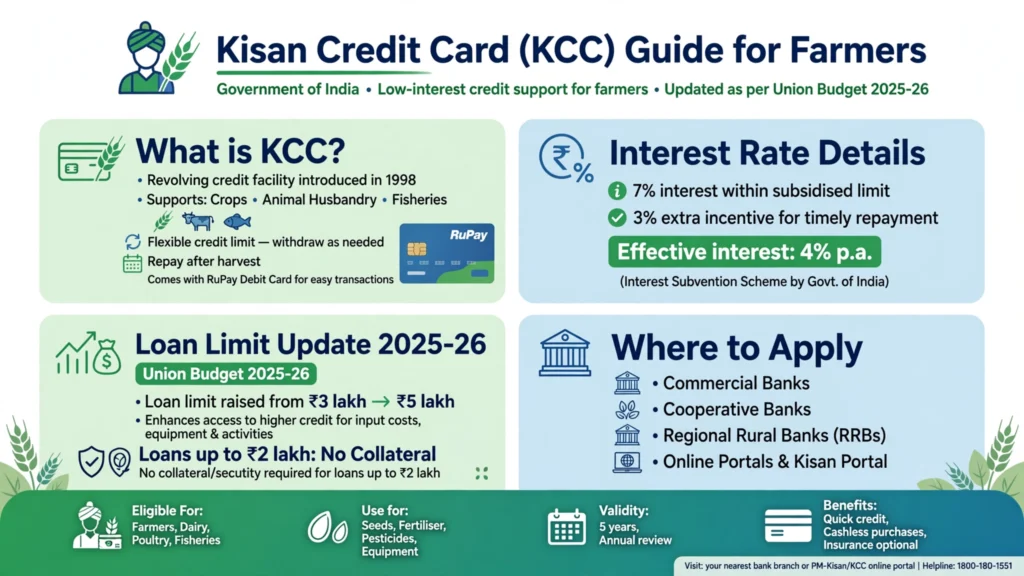
The KCC is a revolving credit facility for farmers, introduced in 1998. Instead of applying for a new loan every season, the farmer gets a credit limit and can withdraw money as needed for seeds, fertilisers, pesticides, feed, labour and other costs, then repay after harvest.
The card works like a bank account with a credit limit, and farmers usually also get a RuPay debit card to withdraw cash or pay at shops.
Key features
| Feature | Details |
| Purpose | Crop cultivation, post-harvest expenses, farm maintenance, animal husbandry, fisheries and household needs |
| Interest rate | 7% for short-term loans within the subsidised limit |
| Prompt repayment incentive | Extra 3%, making the effective rate 4% |
| Subsidised limit | Raised from ₹3 lakh to ₹5 lakh (announced in Union Budget 2025-26) |
| Collateral-free limit | Up to ₹2 lakh |
| Validity | Up to 5 years, reviewed every year |
| Calamity relief | Interest relief during natural calamities, as per rules |
| Insurance | Crops notified under PMFBY can be covered; personal accident cover is also offered |
Who is eligible?
- Owner-cultivator farmers (individual or joint borrowers)
- Tenant farmers, oral lessees and sharecroppers
- Self-Help Groups (SHGs) and Joint Liability Groups (JLGs) of farmers
- Farmers engaged in animal husbandry (dairy, poultry, goats, pigs) and fisheries, under the KCC for allied activities
Banks may also have age criteria and ask for a co-borrower for older applicants.
How is the KCC limit calculated?
The limit is usually based on:
- The crops you grow and the area cultivated
- The scale of finance fixed for each crop by the district-level technical committee
- Post-harvest and maintenance needs
- Farm asset maintenance and consumption needs
- For animal husbandry and fisheries, the number of animals, ponds or boats, and their running costs
The limit is reviewed and can be increased every year based on your repayment and needs.
Documents required
- Duly filled KCC application form
- Identity proof: Aadhaar, voter ID, PAN or driving licence
- Address proof
- Land records showing ownership or cultivation rights (or a tenancy agreement or certificate for tenant farmers, where available)
- Crop details (crops grown and area)
- Passport-size photographs
- For animal husbandry or fisheries: details of animals, sheds or fish ponds
PM-Kisan beneficiaries: if you already receive PM-Kisan payments, banks have a simplified one-page KCC form, because your basic details are already verified.
How to apply for a Kisan Credit Card
- Visit your nearest bank branch: a commercial bank, regional rural bank, small finance bank or cooperative bank.
- Ask for the KCC application form, or the simplified form if you’re a PM-Kisan beneficiary.
- Fill it in and attach the documents.
- The bank verifies your land and crop details and may visit your farm.
- Once approved, your credit limit is set and the card is issued.
- Go to your bank’s official website and find the Kisan Credit Card section (many large banks offer online KCC applications).
- Fill in your details and upload the documents.
- Submit and note your application reference number.
- The bank contacts you for verification.
Tip: banks are expected to process complete KCC applications quickly. If your application is delayed without reason, ask the branch manager, and escalate to the bank’s grievance cell if needed.
How to use your KCC wisely
- Withdraw only what you need, when you need it. Interest is charged only on the amount used.
- Repay on time to get the 3% prompt repayment incentive and keep your effective rate at 4%.
- Don’t use KCC money for non-farm luxuries. It’s meant for productive farm use.
- Keep the limit active by repaying and renewing each year, which also builds your credit history for bigger loans later, such as for farm machinery or a dairy unit.
Frequently asked questions
What is the maximum KCC loan limit?
The limit depends on your land, crops and needs. Under the interest subvention scheme, the subsidised limit was raised from ₹3 lakh to ₹5 lakh in the Union Budget 2025-26.
What is the KCC interest rate?
7% within the subsidised limit, with an extra 3% incentive for prompt repayment, making the effective rate 4%.
Is collateral needed for a KCC?
Not for loans up to ₹2 lakh. Above that, banks may ask for security such as a mortgage of land.
Can tenant farmers get a KCC?
Yes. Tenant farmers, oral lessees and sharecroppers are eligible, though documentation requirements vary by state and bank.
Can dairy farmers get a KCC?
Yes. KCC covers animal husbandry and fisheries, for working capital needs like feed and medicine.
How long is a KCC valid?
Up to 5 years, with an annual review.
Sources (checked 28 October 2026)
- Drishti IAS, “Kisan Credit Card Scheme”, 14 March 2026 (loan limits, interest, collateral-free limit, validity)
- Business Standard, “Budget 2025-26: Higher loan limit may benefit 10% of KCC accounts”
- Reserve Bank of India, Master Direction on Kisan Credit Card: rbi.org.in
- PM-Kisan portal: pmkisan.gov.in
Interest, limits and procedures can change. Confirm with your bank before applying.
Suggested internal links: Rural business ideas and government schemes · How to start an FPO · Food processing business ideas for rural India