Food Processing Business Ideas for Rural India: Low Investment, High Demand
Food processing turns a raw agricultural product most farmers sell at a low, unprocessed price into a packaged product that sells for significantly more — and it’s one of the most actively funded rural business categories in India right now, with a 35% government subsidy specifically built for it. Here’s what to consider starting, and how the funding actually works.
The PMFME Scheme: How the Funding Works
The Pradhan Mantri Formalisation of Micro Food Processing Enterprises (PMFME) scheme offers a 35% credit-linked capital subsidy, up to ₹10 lakh per unit, with the beneficiary contributing a minimum of 10% of the project cost themselves. The subsidy is released to your lending bank after loan approval, not paid to you directly upfront.
You’re eligible as an individual (18+, with at least a Class 8 education, one applicant per family) or as a group — Self Help Groups, Farmer Producer Organisations, and producer cooperatives are all eligible too, which makes this a natural next step if you’re already part of an SHG or FPO.
The ODOP Advantage
The scheme is organised around ‘One District One Product’ (ODOP) — each of 726 districts across 35 states and union territories has an identified local product prioritised for support, based on local raw material availability and traditional skill. Check your district’s ODOP product; applying for something already identified as your district’s priority often means smoother processing, though non-ODOP products remain eligible too.
Practical Business Ideas Within This Category
- Pickle, chutney and preserve making from locally available produce
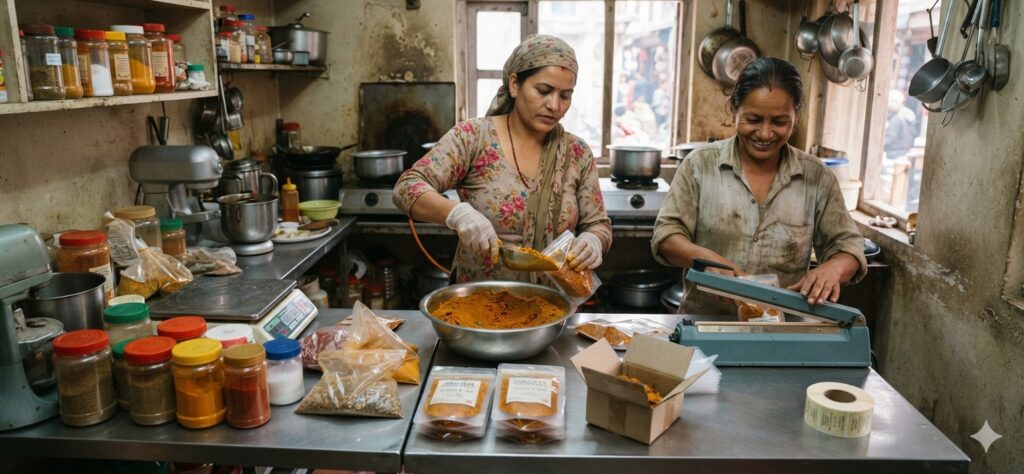
- Spice grinding and blending, packaged under a local brand
- Dried fruit, dehydrated vegetable, or millet-based snack production
- Cold-pressed oil extraction (mustard, groundnut, coconut depending on region)
- Packaged, branded versions of a district’s traditional food product under the ODOP list
How to Apply
Register on the official PMFME portal and submit a project report, machinery quotations, and FSSAI registration (mandatory for any food business in India, separate from the PMFME application itself). Applications go through district-level review before bank appraisal and subsidy release — starting your FSSAI registration early, since it’s a prerequisite, prevents it from becoming a bottleneck later.
Frequently Asked Questions
How much subsidy can I get for a food processing business under PMFME?
A 35% credit-linked capital subsidy, up to a maximum of ₹10 lakh per unit, with the beneficiary contributing a minimum of 10% of the project cost.
Do I need FSSAI registration to apply for PMFME?
Yes, FSSAI registration is required as part of the application, since it’s mandatory for any food business in India regardless of the funding scheme. It’s worth starting this early since it can otherwise delay your PMFME application.
Can a Self-Help Group or FPO apply for PMFME, not just an individual?
Yes — SHGs, Farmer Producer Organisations, and producer cooperatives are all eligible applicants under the scheme, alongside individual entrepreneurs.