20 Interview Questions Indian Recruiters Ask, and How to Answer Them
How to use this guide
For each question, we explain what the interviewer is really checking, and give a short sample answer you can adapt. Don’t memorise word for word; interviewers can tell. Understand the idea and say it in your own words.
Part 1: Introduction questions
1. “Tell me about yourself.”
What they want: a 60–90 second summary that connects your background to this job.
Formula: Present (current role or study) → Past (relevant experience or projects) → Future (why this role).
Sample (fresher): “I recently completed my B.Com from Indore. During college I did a three-month internship in accounts at a CA firm, where I handled GST data entry and reconciliation in Tally Prime. I enjoyed working with numbers and deadlines, so I’m keen to start my career as an accounts executive, and this role matches the skills I’ve built.”
2. “Walk me through your resume.”
Highlight 2–3 key experiences, not every line. Link each to the job you’re applying for.
3. “Why do you want to work here?”
What they want: proof you researched the company.
Sample: “I’ve followed your company’s growth in Tier-2 cities, and I like that you focus on small business customers. My experience in field sales with local retailers fits that well.”
4. “What do you know about our company?”
Mention what they do, key products, customers, and something recent (a launch, expansion or award). Check their website, LinkedIn and recent news.
Part 2: Strengths and fit
5. “What are your strengths?”
Pick 2–3 strengths relevant to the job and prove each with an example.
Sample: “I’m organised and dependable. In my last role I managed follow-ups for 150 leads in a CRM and didn’t miss a single scheduled callback in six months.”
6. “What is your biggest weakness?”
Choose a real but manageable weakness and show how you’re improving it.
Sample: “I used to hesitate to speak up in meetings. I’ve been practising by preparing two points before each meeting, and now I regularly share ideas.”
Avoid clichés like “I’m a perfectionist.”
7. “Why should we hire you?”
Match your skills to their needs in three points: skill, experience, attitude.
8. “How do you handle pressure or deadlines?”
Give a specific example where you planned, prioritised and delivered.
9. “Do you prefer working alone or in a team?”
Show you can do both, with an example of each.
10. “What motivates you?”
Connect to the role: solving problems, helping customers, learning, hitting targets.
Part 3: Behaviour questions (use STAR)
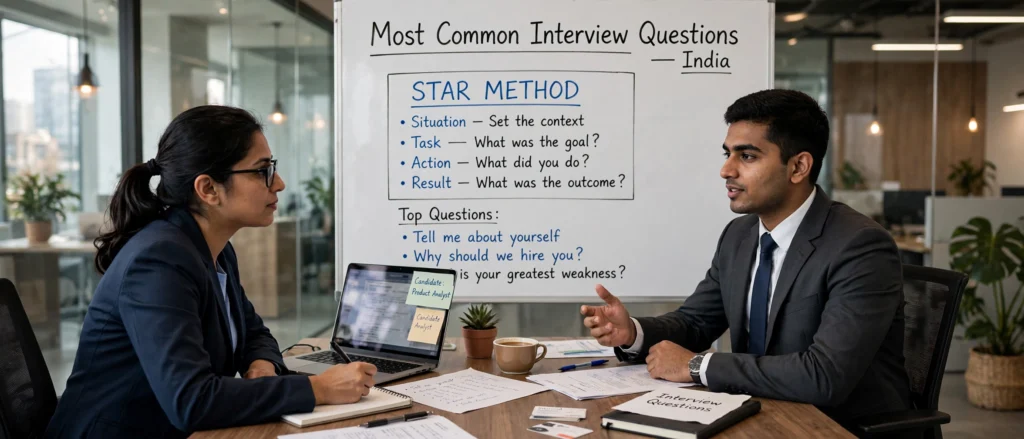
STAR method:
- Situation: the context
- Task: what you had to do
- Action: what you did
- Result: the outcome, with numbers if possible
11. “Tell me about a challenge you faced and how you handled it.”
12. “Tell me about a time you made a mistake.”
Own it, explain what you did to fix it, and what you learned.
13. “Describe a time you disagreed with your manager or a colleague.”
Show you stayed respectful, used facts, and focused on the shared goal.
14. “Tell me about your biggest achievement.”
Choose something relevant and measurable.
Part 4: Career and job-change questions
15. “Why are you leaving your current job?”
Stay positive. Focus on growth, learning or a better fit. Never criticise your current employer.
Sample: “I’ve learned a lot in my current role, but I’m looking for a position with more responsibility in digital marketing, which this role offers.”
16. “Why is there a gap in your resume?”
Be honest and brief: family responsibilities, studies, health, preparing for exams, or starting a business. Mention what you learned or did during the gap. See how to switch careers after 30.
17. “Where do you see yourself in five years?”
Show ambition that fits the company: “I’d like to grow into a team lead role in this department, with deeper expertise in…”
Part 5: Salary and closing questions
18. “What are your salary expectations?”
Research the market range for the role and city. Give a range based on your skills, and say you’re open to discussing the full package.
19. “What is your notice period?”
Answer honestly. If it’s long, mention whether buyout or early release is possible.
20. “Do you have any questions for us?”
Always ask 1–2 questions:
- “What would success look like in this role in the first three months?”
- “What are the biggest challenges the team is facing right now?”
- “How do you support learning and growth?”
Interview day checklist
- Research the company and the job description
- Prepare 4–5 STAR stories from your experience
- Keep printed copies of your resume (for in-person interviews)
- Test your internet, camera and microphone (for online interviews)
- Dress neatly and arrive or log in 10 minutes early
- Send a short thank-you email or message after the interview
Make sure your resume gets you shortlisted first. Read our guide to an ATS-friendly resume.
Frequently asked questions
How do I answer “Tell me about yourself” as a fresher?
Mention your education, relevant projects or internships, key skills, and why you want this role, in about 60–90 seconds.
How should I answer salary questions?
Research the market range for the role and city, then give a range and stay open to discussing the full package.
What is the STAR method?
A way to answer behaviour questions: describe the Situation, your Task, the Action you took and the Result.
Is it okay to say “I don’t know” in an interview?
Yes, if you follow it with how you would find the answer. Honesty is better than guessing.
How can I reduce interview nervousness?
Practise answers out loud, do mock interviews with a friend, and prepare your examples in advance. Our 60-day spoken English plan also helps with confidence.