GST Return Filing for Beginners: GSTR-1 and GSTR-3B Explained
Who needs to file GST returns?
Everyone registered under GST must file returns, even if there were no sales in the period (nil returns). Composition scheme taxpayers file different, simpler returns (CMP-08 quarterly and GSTR-4 annually).
If you’ve just registered, see our GST registration guide.
GSTR-1 vs GSTR-3B
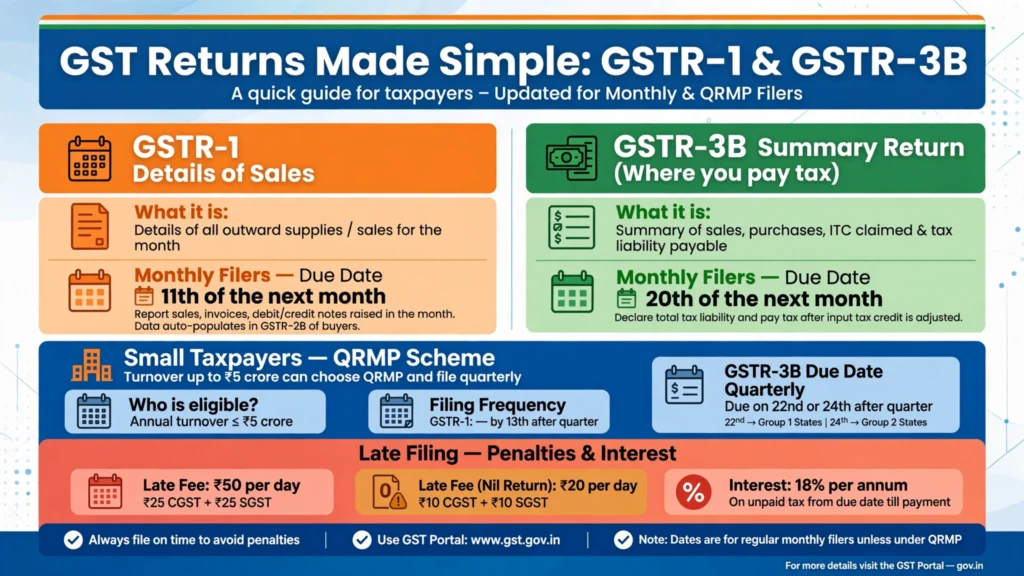
| Point | GSTR-1 | GSTR-3B |
| What it reports | Invoice-level details of outward supplies (sales) | Summary of sales, input tax credit (ITC) and tax payable |
| Tax payment | No | Yes: tax is paid with this return |
| Monthly due date | 11th of the next month | 20th of the next month |
| Quarterly (QRMP) | 13th of the month after the quarter (optional IFF for B2B invoices in the first two months) | 22nd or 24th of the month after the quarter, depending on the state |
| Why it matters | Your buyers’ ITC depends on it | Your tax liability and ITC claim |
The QRMP scheme for small businesses
Taxpayers with turnover up to ₹5 crore can opt for Quarterly Return Monthly Payment (QRMP):
- File GSTR-1 and GSTR-3B quarterly
- Pay tax monthly in the first two months of the quarter using PMT-06
- Optionally upload B2B invoices monthly through the Invoice Furnishing Facility (IFF), so your buyers can claim ITC on time
QRMP reduces filing work for many small businesses.
Important recent changes
- Auto-populated liability locked: from the July 2025 tax period, the tax liability auto-populated in GSTR-3B from your GSTR-1 can’t be edited in GSTR-3B. Correct mistakes in GSTR-1 (or its amendment) before filing GSTR-3B.
- Three-year limit: returns can’t be filed after three years from their original due date. Old pending returns should be filed quickly.
Step-by-step: how to file GSTR-1
- Log in to gst.gov.in → Services → Returns → Returns Dashboard.
- Select the financial year and return period.
- Open GSTR-1 and enter or upload invoice details:
- B2B invoices (sales to registered businesses, with their GSTIN)
- B2C sales (large and small)
- Credit and debit notes
- Exports, nil-rated and exempt supplies
- HSN-wise summary and document summary
- Click “Generate GSTR-1 summary” and check it.
- File with DSC or EVC (OTP).
Step-by-step: how to file GSTR-3B
- Open GSTR-3B for the same period.
- Check the auto-populated sales details (from GSTR-1) and ITC details (from GSTR-2B).
- Make sure you claim only eligible ITC: match it with GSTR-2B and your purchase records.
- Check the tax payable after using ITC.
- Pay any remaining tax in cash through the electronic cash ledger (create a challan if needed).
- Offset liability and file with DSC or EVC.
Late fees and interest
| Situation | Consequence |
| Late GSTR-3B or GSTR-1 (with tax liability) | Late fee of ₹50 per day (CGST + SGST), subject to caps |
| Late nil return | Late fee of ₹20 per day, subject to caps |
| Late tax payment | Interest at 18% per year on the unpaid tax |
| Continuous non-filing | Blocking of e-way bills, and possible cancellation of registration |
Monthly GST checklist
- Issue proper GST invoices for every sale
- Record all purchase bills and check that suppliers have filed their GSTR-1
- Reconcile purchases with GSTR-2B before claiming ITC
- File GSTR-1 on time so your buyers get credit
- File GSTR-3B and pay tax on time
- Keep records for audits and assessments
Tools that make it easier
Billing and accounting software can generate GST-ready invoices and return data. See our list of free invoicing and accounting tools. If your business is growing, a CA or GST practitioner can file for you at an affordable monthly fee.
Frequently asked questions
What is the due date for GSTR-3B?
The 20th of the next month for monthly filers. Quarterly (QRMP) filers file by the 22nd or 24th of the month after the quarter, depending on their state.
What is the due date for GSTR-1?
The 11th of the next month for monthly filers, and the 13th of the month after the quarter for QRMP filers.
Do I need to file GST returns if I had no sales?
Yes. You must file nil returns even if there were no transactions.
What is the late fee for GSTR-3B?
₹50 per day (₹20 per day for nil returns), subject to caps, plus 18% interest on unpaid tax.
Can I file old GST returns anytime?
No. From the July 2025 tax period onwards, returns can’t be filed after three years from their due date.
What is the difference between GSTR-1 and GSTR-3B?
GSTR-1 reports invoice-level sales. GSTR-3B is a summary return through which you claim input tax credit and pay tax.
Sources (checked 21 November 2026)
- GST portal: gst.gov.in
- ClearTax, “GSTR-3B: due date, late fee and filing” (hard-locking from July 2025; three-year limit; late fees)