
7 Free Tools Every New Entrepreneur in India Needs in 2026
Before you spend money on paid software, there’s a short list of free, official and genuinely useful tools every new entrepreneur in India should have bookmarked. Here are 7 worth setting up this week, plus a simple EMI formula and business plan structure you can use right now.
1. Udyam Registration Portal
Your MSME registration is the foundation almost everything else builds on — scheme eligibility, certain tenders, and some bank loan applications all ask for it. It’s free, done entirely online, and takes most applicants under 20 minutes.
2. Udyamimitra / JanSamarth Portal
This is where you actually apply for Mudra Loans and several other government-backed credit schemes online, track application status, and compare eligible lenders in one place, rather than approaching banks individually one at a time.
3. The GST Portal
Even before you’re required to register, the GST portal’s own threshold and rate information is the most reliable source — more reliable than most blog posts, including this one — for the exact current numbers that apply to your state and business type.
4. Google Business Profile
Free, and often the single highest-impact marketing tool available to a local business — covered in detail in our SEO and social media playbook.
5. Canva (Free Tier)
For product photos, social posts, and basic branding, Canva’s free plan covers most of what a new small business needs before it makes sense to hire a designer.
6. A Simple EMI Calculator (and the Formula Behind It)
Before taking any loan — Mudra, PMEGP-linked, or private — know your monthly repayment in advance. The formula is: EMI = [P × R × (1+R)^N] / [(1+R)^N − 1], where P is the loan amount, R is the monthly interest rate (annual rate ÷ 12 ÷ 100), and N is the number of monthly instalments.
You don’t need to calculate this by hand — most bank websites and the JanSamarth portal offer a free calculator — but understanding the formula helps you sanity-check any number a lender gives you.
7. A One-Page Business Plan Template
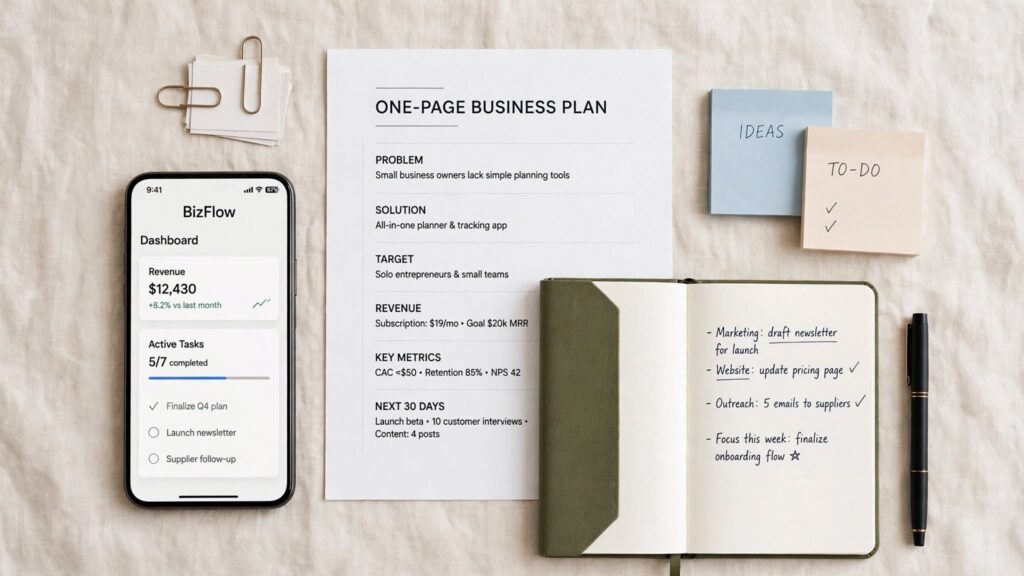
You don’t need a 40-page document to apply for most schemes or convince yourself an idea is worth pursuing. A working one-pager covers: the problem you’re solving, who pays you and why, your cost to deliver it, your price, your break-even point (roughly: fixed costs ÷ (price − cost per unit)), and your funding source. If you can’t fill this in confidently, that’s more useful information than any amount of further research.
Frequently Asked Questions
Is Udyam registration free?
Yes, Udyam (MSME) registration is completely free through the official government portal, and takes most applicants under 20 minutes to complete online.
How do I calculate my loan EMI before applying?
Use the formula EMI = [P × R × (1+R)^N] / [(1+R)^N − 1], where P is the loan amount, R is the monthly interest rate, and N is the number of months — or use a free EMI calculator on your bank’s website or the JanSamarth portal for a quicker result.
What should a one-page business plan include at minimum?
At minimum: the specific problem you solve, who pays you, your cost per unit, your price, your break-even point, and where your starting funding comes from. If you can answer all six clearly, you have a workable plan.