
15 Low-Investment Business Ideas You Can Start in India Under ₹50,000 (2026)
You don’t need lakhs of rupees or a bank loan to start earning on your own terms. Most first businesses in India today start with a skill, a phone, and under ₹50,000 — and grow from there. Below are 15 low-investment business ideas that real people are running profitably in 2026, along with what each one actually costs to start and the first step to take this week.
1. Home Tiffin or Meal Service
If you can cook well and consistently, this is still one of the fastest ways to get your first paying customers — students, PGs, and working professionals order daily. Starting cost is mostly utensils and packaging, roughly ₹8,000–₹15,000, since you’re likely already using your home kitchen.
Start by offering 10 tiffins a day in your own neighbourhood before you try to scale — word of mouth here beats any ad spend.
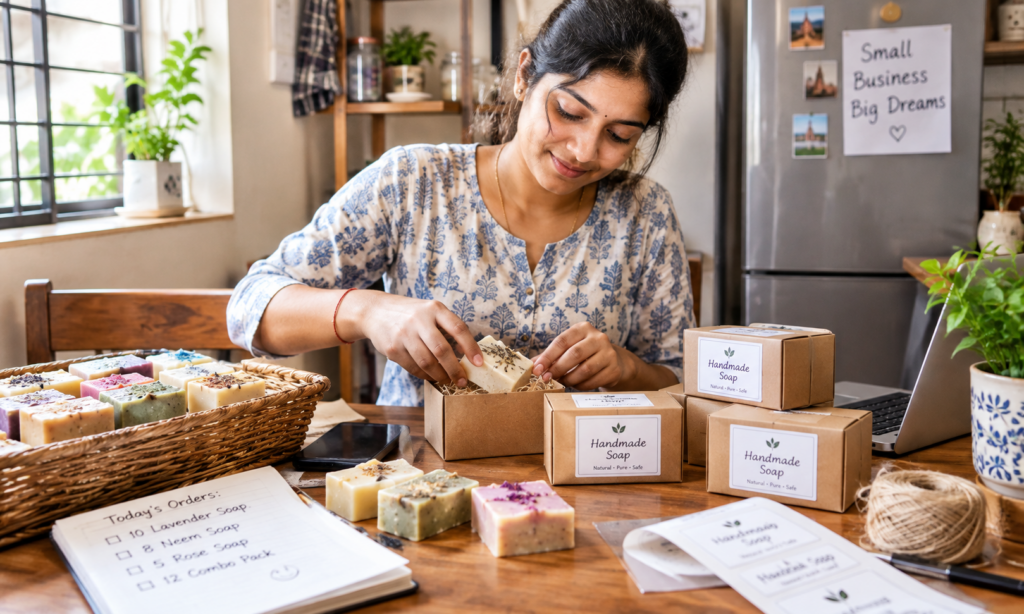
2. Handmade Soap, Candle or Incense Making
Raw materials, moulds and basic packaging can be sourced for ₹10,000–₹20,000. The real skill here is presentation and a consistent scent or design line — this is a category where Instagram sells the product better than a website does.
3. Social Media Management for Local Shops
Every local shop, salon and clinic wants an Instagram presence but doesn’t have time to run it. If you can shoot decent phone photos and write a caption, you can charge ₹3,000–₹8,000 per client per month with zero inventory cost — just your phone and time.
4. Mobile Repair & Accessories Kiosk
A small stock of screen guards, cables and basic repair tools costs around ₹25,000–₹40,000. This works best in high-footfall areas — near colleges, markets, or metro stations.
5. Reselling via WhatsApp and Instagram
No warehouse, no shop — you list products (clothing, jewellery, home decor) from a wholesaler or manufacturer and take orders directly through chat. Starting capital is close to zero if you work on a per-order basis with your supplier.
6. Tutoring or Skill Coaching
Academic tuition, spoken English, or even a hobby class (music, art, yoga) needs almost no capital beyond a notebook and a few flyers. Online, a smartphone and a stable internet connection is all you need to start.
7. Event Decoration for Small Functions
Balloon décor, small birthday setups, and return-gift arrangements are in constant local demand. A starter kit of balloons, lights and basic props runs ₹15,000–₹25,000.
8. Dry Fruits, Spices or Ghee Trading
Buying in bulk from a wholesale market and repackaging under your own small brand for local sale needs roughly ₹20,000–₹35,000 for your first stock.
9. Freelance Writing, Design or Video Editing
If you already have the skill, this needs almost no money — just a laptop you likely already own and a profile on a freelancing platform. This is also the easiest idea to test alongside a full-time job before going all-in.
10–15. Quick-Fire Ideas Worth Exploring
A few more that consistently work at low capital: a niche cloud kitchen (one dish, done well), homemade pickles or bakery products, tailoring and alteration services, a mobile car-wash and detailing service, upcycled or recycled home-decor products, and freelancing with AI tools — many small businesses now pay for help with AI-generated content, product images or data entry, and this skill alone can be monetised with almost no upfront cost.
How to Pick the Right Idea for You
Before you commit money, ask three questions: Do I already have this skill, or can I learn it in under a month? Is there visible local demand — have I actually seen people paying for this nearby? And can I test it small, with 5–10 customers, before scaling? If a business idea doesn’t survive a small test, it won’t survive a big investment either.
If your idea needs more capital than you have on hand, don’t rule it out — several government schemes exist specifically to fund first-time entrepreneurs at low or subsidised interest. We break these down in detail in our government schemes guide.
Frequently Asked Questions
Which business can I start in India with less than ₹10,000?
Freelance services (writing, design, social media management, tutoring) need almost no capital since you’re monetising a skill you already have, not buying inventory. Reselling on WhatsApp/Instagram on a per-order basis is close behind.
Do I need a licence to start a small home-based business in India?
Most very small, unregistered home businesses can start informally, but as revenue grows you’ll typically need an Udyam (MSME) registration, and a GST registration once you cross the applicable turnover threshold. Registering early also makes you eligible for government scheme funding.
What’s the safest way to test a business idea before investing money?
Sell to 5–10 real customers first — friends, neighbours, or a small local WhatsApp group — before spending on inventory, branding or a shop. If people won’t pay at a small scale, a bigger investment won’t fix that.