CGTMSE Explained: How to Get a Collateral-Free Business Loan
What is CGTMSE?
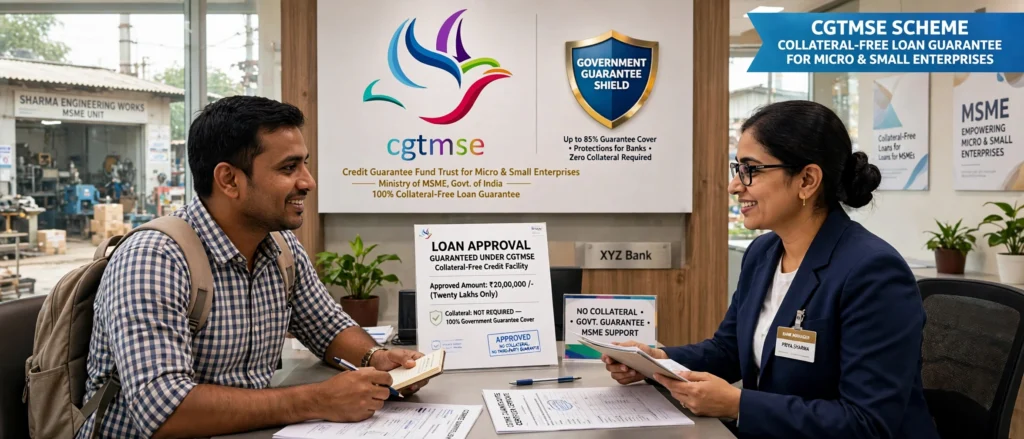
CGTMSE was set up by the Ministry of MSME and SIDBI. When a bank gives a loan to a micro or small enterprise, CGTMSE promises to cover a large part of the loss if the borrower can’t repay. Because the bank’s risk is lower, it can lend without asking for property or other collateral.
This matters because many small business owners, especially first-generation entrepreneurs and women, don’t have property to pledge.
Key features at a glance
| Feature | Details |
| Who runs it | Ministry of MSME and SIDBI |
| Maximum guarantee | Up to ₹10 crore per borrower (raised from ₹5 crore) |
| Collateral | Not required; no third-party guarantee either |
| Coverage | Typically 75% to 85% of the loan amount, higher for micro enterprises, women entrepreneurs and special categories |
| Loan types | Term loans and working capital (including cash credit) |
| Fee | Annual guarantee fee, usually paid by the borrower through the lender |
| How to apply | Through Member Lending Institutions: banks, regional rural banks, small finance banks and eligible NBFCs |
Who is eligible?
- New and existing micro and small enterprises in manufacturing and services
- Retail trade businesses, within the limits set by the trust
- Units registered under Udyam, which helps establish MSE status
- Special benefits for women entrepreneurs, SC/ST entrepreneurs, persons with disabilities, transgender entrepreneurs, informal micro enterprises and ZED-certified units, as well as units in Jammu & Kashmir and Ladakh
Not covered: medium and large enterprises, personal or consumption loans, agricultural activities and some other excluded categories.
How much does CGTMSE cost?
You pay an annual guarantee fee (AGF), calculated on the guaranteed amount. The rate depends on the loan size and borrower category: it’s lowest for small loans and higher for larger loans. CGTMSE has revised and reduced fees in recent years, including for guarantees above ₹1 crore.
Ask your bank for the current fee before signing, and include it in your loan cost calculation.
How to get a CGTMSE-backed loan: step by step
- Register your business on Udyam (free) to establish MSE status. See our Udyam registration guide.
- Prepare a project report or business plan: what the loan is for, costs, expected sales, and how you’ll repay.
- Check your credit score and fix any errors first. Read how to improve your CIBIL score.
- Approach a bank or eligible lender and ask specifically for a collateral-free loan under CGTMSE.
- Submit documents: KYC, Udyam certificate, GST registration (if applicable), bank statements, ITRs, quotations for machinery, and the project report.
- The lender appraises your loan and, if approved, applies to CGTMSE for the guarantee.
- Pay the guarantee fee as advised by the lender, and receive the loan.
Documents usually needed
- Aadhaar and PAN of the owner, partners or directors
- Udyam registration certificate
- GST registration (if applicable)
- Business address proof
- Bank statements (6–12 months)
- ITRs and financial statements for existing businesses
- Project report and machinery quotations
Tips to improve your chances
- Ask clearly for CGTMSE cover. Some branches default to asking for collateral.
- Show a realistic repayment plan. Banks care most about cash flow.
- Keep business transactions in a separate current account. See why separating personal and business finances matters.
- Combine with schemes like Mudra or PMEGP, where applicable. Compare them in our guide to PMEGP vs Mudra vs Stand-Up India.
- If refused, ask for the reason in writing and try another bank. CGTMSE works with many lenders.
Frequently asked questions
What is the maximum loan under CGTMSE?
The guarantee ceiling is ₹10 crore per borrower, as raised by the government. The actual loan amount depends on the bank’s appraisal.
Can I apply for CGTMSE directly?
No. You apply for a loan at a bank or eligible lender, which then seeks the CGTMSE guarantee.
Is CGTMSE available for new businesses?
Yes. Both new and existing micro and small enterprises can benefit.
Who pays the CGTMSE fee?
The annual guarantee fee is usually passed on to the borrower. Ask your lender for the exact amount.
Do women entrepreneurs get extra benefits?
Yes. Women-owned micro and small enterprises typically get higher guarantee coverage and may get fee concessions.
Does CGTMSE cover traders?
Retail trade activities are eligible within the limits set by CGTMSE. Check with your lender.
Sources (checked 21 November 2026)
- CGTMSE official website: cgtmse.in
- Ministry of MSME: msme.gov.in
- IIFL Finance, “CGTMSE Scheme India 2026” (coverage percentages)
Fees and coverage rules are revised from time to time. Confirm current terms with your bank or on cgtmse.in.