How to Validate a Business Idea in 30 Days Before Investing Money
Why validation matters
Many new businesses fail not because the founder didn’t work hard, but because not enough people wanted to buy the product at a price that made a profit. Validation helps you find this out early, while it still costs very little, before you sign a shop lease, buy machines or take a loan.
The golden rule: compliments are not customers
Friends and family will often say “great idea!” to be supportive. That’s not proof. Real validation is when strangers:
- Pay money, or pay an advance
- Pre-book or join a waiting list with their phone number
- Come back and buy again
Your 30-day validation plan
Week 1: Define the problem and the customer
Write down, on one page:
- The problem: what pain are you solving? (e.g. “Working parents in my area struggle to find healthy evening snacks for children.”)
- The customer: who exactly has this problem? Age, location, income, habits.
- Your solution: what will you offer?
- How you’ll make money: price, cost and expected margin.
Also check search demand. Type your product into Google and look at the suggestions and “People also ask” questions. Check Google Trends for interest over time in your state.
Week 2: Talk to 20–30 potential customers
This is the most important step. Talk to people who match your customer description, not just friends.
Ask about their past behaviour, not opinions:
- “How do you solve this problem today?”
- “What did you spend on it last month?”
- “What’s the most frustrating part?”
- “What would make you switch?”
Avoid leading questions like “Would you buy my amazing product?” People say yes to be polite.
Note common answers. If most people don’t see the problem as important, rethink the idea.
Week 3: Study the competition and pricing
| Check | How |
| Who else sells this? | Google Maps, Instagram, Amazon, Flipkart, Meesho, JustDial, local markets |
| What do they charge? | Visit, call or check online prices |
| What do customers complain about? | Read Google, Amazon and social media reviews |
| How are they reaching customers? | Look at their ads, social media and shop locations |
Competition isn’t bad. It often proves demand exists. Your job is to find a gap: better quality, faster service, a specific niche, a better location, or a lower price with lower costs.
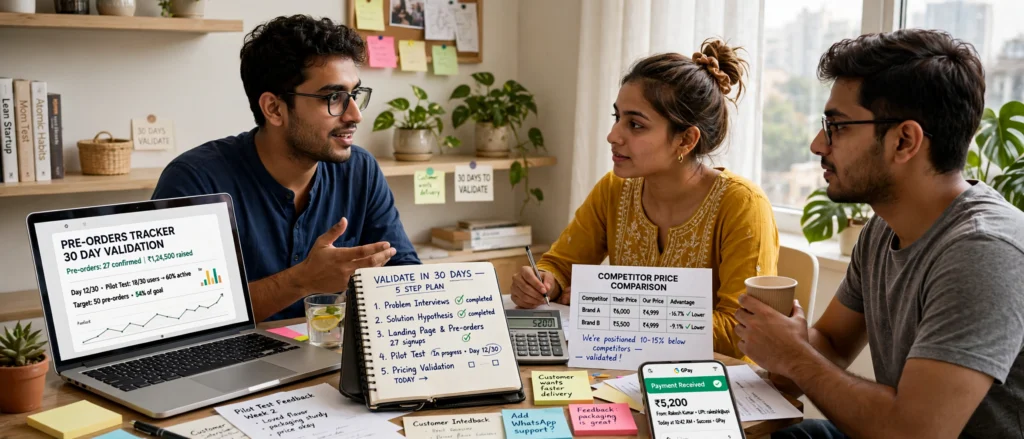
Week 4: Run a small paid test
Now test whether people will actually pay. Choose one:
| Test | Example | Cost |
| Pre-orders | Take advance bookings for festive gift boxes | Very low |
| Pilot service | Offer tuition, repair or cleaning to 5–10 customers | Low |
| Small batch | Make 50 units and sell through WhatsApp and local shops | Low to moderate |
| Simple landing page | A free page with price and “Book now” button, promoted with ₹1,000–₹2,000 of ads | Low |
| Stall or exhibition | One weekend at a local market or fair | Moderate |
Track: how many people saw your offer, how many enquired, how many paid, and what feedback they gave.
How to decide: go, change or stop
At the end of 30 days, look at the numbers:
| Signal | What it means |
| People paid or pre-booked, and some came back | Go ahead, starting small |
| Many enquiries but few payments | Change the price, offer or target customer, then test again |
| Little interest even after promotion | Stop or pivot. You’ve saved money and learned a lot. |
Also do a quick profit check: at a realistic price and sales volume, will the business cover all costs and pay you a fair income? If not, the idea needs changing.
Tools you can use for free
- Google Forms for customer surveys
- Google Trends and Google search suggestions for demand signals
- WhatsApp Business for catalogues and pre-orders
- Canva for simple flyers and posts
- Free website builders for a one-page offer
See our list of free tools for new entrepreneurs.
Common validation mistakes
- Asking only friends and family
- Building the full product before testing
- Ignoring negative feedback
- Testing for one day and giving up
- Not calculating profit, only revenue
Frequently asked questions
How do I know if my business idea is good?
When real customers pay for it, come back, or pre-book, and when the numbers show the business can make a profit.
How much money do I need to validate an idea?
Often very little: ₹0 to ₹10,000 for surveys, a small batch, a pilot service or a few days of ads.
What is an MVP?
A Minimum Viable Product is the simplest version of your product that solves the core problem, so you can test it with real customers quickly.
Should I register my business before validating?
You can test with informal pre-orders or pilots first. Once you start selling regularly, complete the required registrations, such as FSSAI for food or GST where applicable.
What if someone copies my idea?
Ideas are common. Execution, customer service and speed matter more. Talking to customers is far less risky than building something nobody buys.