Legal Rights Every Working Woman in India Should Know
1. Equal pay and no discrimination
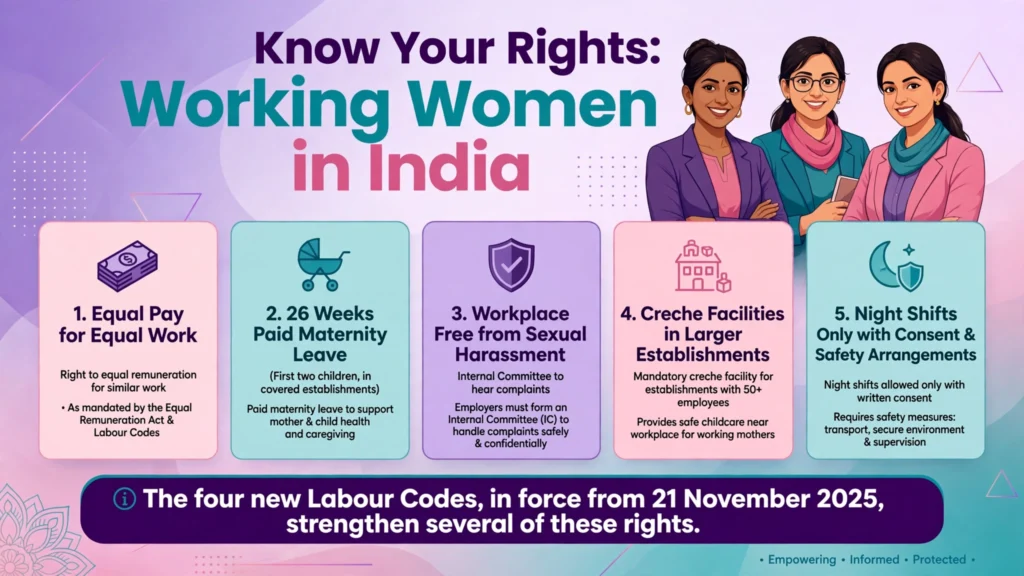
Under the Code on Wages, employers can’t discriminate on the basis of gender in wages for the same or similar work, or in recruitment and conditions of employment. The government’s summary of the new labour codes says equal pay for equal work is ensured and gender discrimination is legally prohibited, including against transgender persons.
What you can do: if you’re paid less than male colleagues for the same work, raise it with HR in writing first, then approach the labour department if it isn’t resolved.
2. Maternity benefits
Maternity benefits, earlier under the Maternity Benefit Act, 1961, are now part of the Code on Social Security.
| Benefit | Key points |
| Paid maternity leave | 26 weeks for the first two children; 12 weeks for the third child onwards |
| Adoption and commissioning mothers | 12 weeks’ leave for adopting a child below 3 months, or for a commissioning mother |
| Work from home | May be allowed after maternity leave, if the nature of work permits and as agreed with the employer |
| Crèche | Establishments above a specified number of employees must provide crèche facilities, with visits allowed during the day |
| Protection | Dismissal during maternity leave because of pregnancy is not allowed |
Eligibility usually requires having worked for a minimum number of days with the employer before the expected delivery. Check your company policy and the current rules.
3. Protection from sexual harassment (POSH Act, 2013)
The Sexual Harassment of Women at Workplace (Prevention, Prohibition and Redressal) Act, 2013, protects women at all workplaces, including offices, factories, shops, hospitals, schools and even domestic workers’ workplaces.
Key points:
- Internal Committee (IC): every workplace with 10 or more employees must set up an Internal Committee, headed by a senior woman employee and including an external member.
- Local Committee: for workplaces with fewer than 10 employees, or when the complaint is against the employer, complaints go to the Local Committee set up by the District Officer.
- Complaint timeline: a written complaint should generally be made within 3 months of the incident (extendable by another 3 months in some cases).
- Confidentiality: the identity of the complainant and the details must be kept confidential.
- No retaliation: you shouldn’t face punishment or victimisation for complaining.
What counts as sexual harassment: unwelcome physical contact, requests for sexual favours, sexually coloured remarks, showing pornography, and any other unwelcome physical, verbal or non-verbal conduct of a sexual nature.
You can also file a complaint on the government’s SHe-Box portal (shebox.wcd.gov.in).
4. Night shifts and all types of work
Under the new labour codes, women can work in all establishments and all types of work, including night shifts, but only with their consent and with safety measures in place. The government’s summary mentions safeguards such as written consent, safe transport, CCTV and security arrangements. You can’t be forced into night shifts.
5. Appointment letters and written terms
The labour codes require employers to give appointment letters to workers. This gives you written proof of your job, wages and terms, which is useful if any dispute arises.
6. Social security and family coverage
Under the new codes, female employees can include parents-in-law as dependants for certain benefits. Women in covered establishments get EPF and ESI benefits, like all employees. Gig and platform workers, many of them women, are also being brought under social security schemes.
7. Representation on grievance committees
The labour codes require women’s representation on grievance redressal committees, so women’s concerns are heard in workplace dispute processes.
8. Other useful protections
- Separate washrooms and basic facilities at the workplace
- Working hours and overtime limits as per law, with overtime pay
- Protection from dismissal for raising a legitimate complaint
Where to get help
| Problem | Where to go |
| Sexual harassment at work | Internal Committee; Local Committee (District Officer); SHe-Box portal |
| Unequal pay, wage issues, maternity benefits | Company HR; state labour department |
| Workplace harassment or violence | Police; Women Helpline 181 (in many states); emergency 112 |
| Cyber harassment | cybercrime.gov.in; helpline 1930 |
| Legal aid | District Legal Services Authority (free legal aid for women) |
Practical tips
- Keep copies of your appointment letter, salary slips and important emails
- Read your company’s HR, leave and POSH policies
- Document incidents with dates, times and witnesses
- Raise complaints in writing and keep a copy
Frequently asked questions
How many weeks of maternity leave do women get in India?
26 weeks of paid leave for the first two children, and 12 weeks from the third child onwards, in establishments covered by the law.
Is it compulsory for companies to have a POSH committee?
Yes. Every workplace with 10 or more employees must set up an Internal Committee under the POSH Act.
Can my employer force me to work night shifts?
No. Under the new labour codes, women can work night shifts only with their consent and with safety arrangements in place.
When did the new labour codes come into force?
The four labour codes came into force on 21 November 2025.
Where can I complain about sexual harassment online?
On the government’s SHe-Box portal (shebox.wcd.gov.in), in addition to your workplace’s Internal Committee.
Do these rights apply to private companies?
Yes. These laws apply to private as well as government establishments, subject to coverage conditions such as the number of employees.
Sources (checked 21 November 2026)
- Ministry of Labour and Employment, PIB release on implementation of the four labour codes (21 November 2025): labour.gov.in
- Sexual Harassment of Women at Workplace Act, 2013; SHe-Box: shebox.wcd.gov.in
- Maternity Benefit Act, 1961 (as amended 2017), now covered under the Code on Social Security, 2020