
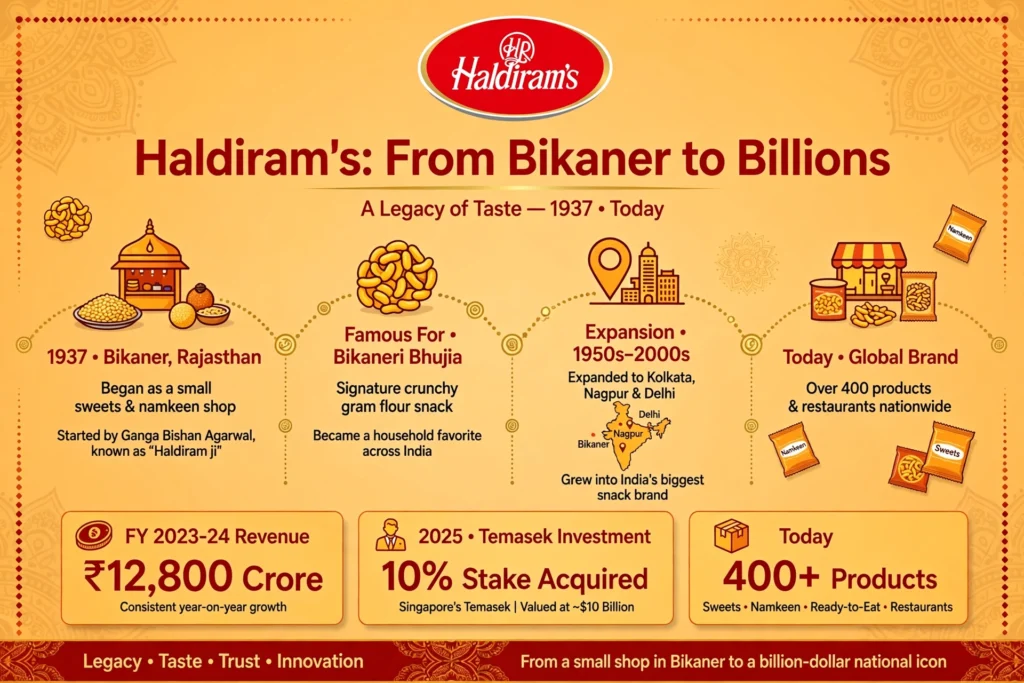
Haldiram’s: From a Bikaner Shop to a Global Snack Brand
Humble beginnings in Bikaner
Bikaner has always been famous for bhujia, a crispy snack made from moth bean flour. In 1937, Ganga Bishan Agarwal opened a small shop selling sweets and namkeen. He made his bhujia thinner and tastier than others, and people started asking for “Haldiram’s bhujia” by name.
Quality and taste made the shop famous locally, and the family began thinking beyond Bikaner.
Growth across India
| Stage | What happened |
| 1937 | Shop started in Bikaner |
| Mid-20th century | Expansion to Kolkata, with a manufacturing plant there |
| 1970 | Larger plant in Jaipur |
| 1970s–1990s | Family members built businesses in Nagpur and Delhi |
| 1990s onwards | Packaged snacks, sweets, restaurants and exports |
| 2022 onwards | Plan to combine the Delhi and Nagpur packaged snack businesses into Haldiram Snacks Food |
| 2025 | Temasek bought about a 10% stake at a valuation near $10 billion |
What makes Haldiram’s successful
1. One hero product
Bhujia gave Haldiram’s its identity. A single, excellent product can build a brand that later supports hundreds of others.
2. Consistent taste at scale
Moving from hand-made to factory-made snacks, while keeping the taste customers loved, was critical.
3. Packaging and distribution
Packaged snacks reached kirana stores, supermarkets, railway stations and airports across India, and later Indian stores abroad.
4. Product range for every occasion
Over 400 products: namkeens, sweets, cookies, ready-to-eat meals, frozen foods and more. Families find something for daily snacks, festivals and gifting.
5. Restaurants that strengthen the brand
Haldiram’s restaurants serve Indian snacks and meals, letting customers experience the brand in person.
6. Professionalising a family business
Different family branches built businesses in different regions. In recent years, combining businesses and bringing in global investors has helped the company prepare for its next stage of growth.
7 lessons for food entrepreneurs and family businesses
- Perfect one product first. Make it so good that people ask for it by name.
- Protect your taste and quality as you grow. Standard recipes and processes matter.
- Invest in packaging. Good packaging extends shelf life and builds trust.
- Use festivals and gifting. Seasonal demand can grow small food businesses fast. See our festive business ideas.
- Get your licences right. Food businesses need FSSAI registration or a licence from day one.
- Plan family roles clearly. Clear ownership and responsibilities prevent conflicts.
- Think beyond your town. Bikaner’s bhujia became a national, then global, product.
How small food businesses can apply these lessons
- Choose one product you make exceptionally well: namkeen, pickle, papad, sweets or spices
- Standardise recipes and quality checks
- Get FSSAI registration and design simple, attractive packaging
- Start with local shops, then sell online through marketplaces, ONDC or WhatsApp
- Use government support for food processing, such as schemes for micro food enterprises
See our guide to food processing business ideas.
Frequently asked questions
Who founded Haldiram’s?
Ganga Bishan Agarwal, popularly known as Haldiram ji, in 1937 in Bikaner, Rajasthan.
What is Haldiram’s famous for?
Its Bikaneri bhujia, along with namkeens, sweets and Indian snacks.
What is Haldiram’s valuation?
In 2025, Temasek bought about a 10% stake at a valuation of nearly $10 billion.
What is Haldiram’s revenue?
Haldiram’s FY 2023-24 revenue was about ₹12,800 crore, according to published figures.
What can small businesses learn from Haldiram’s?
Start with one excellent product, keep quality consistent, invest in packaging and distribution, and plan family business roles clearly.
Sources (checked 21 November 2026)
- Wikipedia, “Haldiram’s” (history, products, FY24 financials, Temasek stake)
- Outlook Business, “Temasek acquires 10% stake in Haldiram Snacks Food at $10 billion valuation”