Goat Farming Business in India: Breeds, Cost, Loans and Profit
Why goat farming?
- Steady demand for goat meat across India, with price peaks during festivals like Bakrid
- Low feed costs: goats eat grasses, shrubs, tree leaves and crop residues
- Fast multiplication: many breeds give birth to twins, sometimes more
- Small space and simple shed compared with cattle
- Quick sale: goats can be sold whenever you need cash
Best goat breeds in India
| Breed | Region | Main use | Notes |
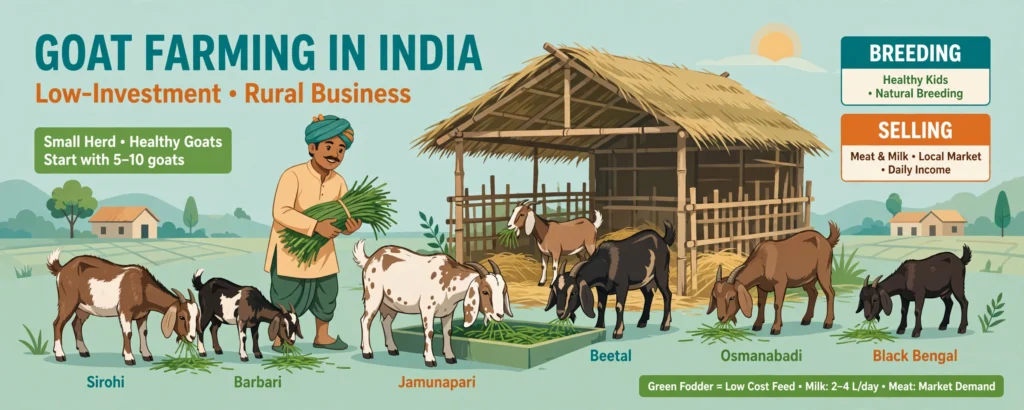
| Sirohi | Rajasthan, Gujarat | Meat and milk | Hardy, good for stall-feeding |
| Barbari | UP, Haryana | Meat and milk | Small size, often gives twins; good for stall-feeding |
| Jamunapari | UP | Milk and meat | Large; needs good feeding |
| Beetal | Punjab, Haryana | Milk and meat | Good milk yield |
| Osmanabadi | Maharashtra | Meat | Adapted to dry regions |
| Black Bengal | West Bengal, Odisha, Assam | Meat | Very prolific breeder; high-quality meat and skin |
Tip: choose a breed that’s common and does well in your region. Local buyers and vets will know it, and animals adapt better.
Farming systems
| System | How it works | Best for |
| Grazing (extensive) | Goats graze on open land during the day | Areas with grazing land; lowest cost |
| Stall-feeding (intensive) | Goats kept in sheds and fed cut fodder and concentrate | Areas without grazing land; easier to manage health |
| Semi-intensive | Some grazing plus supplementary feeding | Most small farmers |
Setup cost for a small unit (20 does + 1 buck)
| Item | Indicative cost (₹) |
| 20 female goats + 1 breeding buck | 1,50,000 – 3,00,000 |
| Shed (raised platform, ventilation, about 300–400 sq ft) | 60,000 – 1,50,000 |
| Feeders, waterers, chaff cutter | 10,000 – 30,000 |
| Feed and fodder for initial months | 20,000 – 40,000 |
| Vaccination, deworming, insurance | 10,000 – 20,000 |
| Total | roughly ₹2.5 – 5.4 lakh |
These are indicative ranges. Prices of animals vary greatly by breed, age and region.
Step-by-step: how to start
- Get training at a KVK, veterinary university, RSETI or state animal husbandry department.
- Plan fodder: grow fodder crops (like napier, maize, berseem) and fodder trees if possible.
- Build a raised, clean shed with good ventilation, dry flooring and separate areas for kids, pregnant does and the buck.
- Buy healthy animals from trusted farmers or government farms. Check age, health and vaccination.
- Follow a health calendar: vaccinations (such as PPR and enterotoxaemia), regular deworming and hoof care, as advised by your local vet.
- Insure your animals.
- Keep records of births, weights, sales and expenses.
- Plan sales around festivals for better prices.
Profit example (20 does, assumed figures)
| Item | Amount (₹) |
| Kids born per year (20 does × 1.5 kiddings × 1.5 kids, minus losses) | ≈ 40 kids |
| Sale of 35 kids at 8–10 months (₹6,000 each, assumed) | 2,10,000 |
| Feed, fodder, labour, vet and other costs (assumed) | (90,000) |
| Net income per year (before loan EMI) | ≈ 1,20,000 |
Income can be higher with good breeds, low mortality, home-grown fodder and festival sales. It can be lower if disease or feed costs are high.
Government support: National Livestock Mission (NLM)
Under the NLM Entrepreneurship Development Programme, individuals, FPOs, SHGs, JLGs, farmer cooperatives and Section 8 companies can get a 50% capital subsidy for sheep or goat breeding units:
| Unit size (female + male) | Maximum subsidy |
| 100 + 5 | ₹10 lakh |
| 200 + 10 | ₹20 lakh |
| 300 + 15 | ₹30 lakh |
| 400 + 20 | ₹40 lakh |
| 500 + 25 | ₹50 lakh |
How to apply:
- Register on the NLM portal: nlm.udyamimitra.in
- Upload a detailed project report (DPR), land documents (owned or leased), ID, bank details and training or experience proof
- The State Implementing Agency reviews the proposal
- The bank sanctions the loan
- Subsidy is released in stages as the project is implemented
Smaller farmers can also check state schemes for goat units, often with special support for women, SC/ST and landless families.
Other finance options
- Bank loans for animal purchase and sheds, with a project report
- Kisan Credit Card for animal husbandry for working capital. See our Kisan Credit Card guide.
- SHG loans for women’s groups
Common mistakes
- Buying animals without checking health or vaccination
- Damp, dirty sheds that cause disease
- Not planning fodder for the dry season
- Inbreeding: change the breeding buck every 2 years or so
- Selling only through middlemen at low prices
Frequently asked questions
How much investment is needed for goat farming?
A small unit of 20 does and 1 buck needs roughly ₹2.5–5.4 lakh, depending on breed and shed costs.
What subsidy is available for goat farming?
Under the National Livestock Mission, a 50% capital subsidy is available for units from 100+5 goats (up to ₹10 lakh) to 500+25 goats (up to ₹50 lakh). Apply at nlm.udyamimitra.in.
Which goat breed is most profitable?
It depends on your region and market. Sirohi, Barbari, Black Bengal, Osmanabadi, Beetal and Jamunapari are popular. Choose a breed suited to your climate and buyers.
Can I do goat farming without grazing land?
Yes. Stall-feeding with cultivated fodder and concentrate works well, especially with breeds like Sirohi and Barbari.
When is the best time to sell goats?
Prices are often highest before festivals like Bakrid. Plan breeding so kids are ready for sale at that time.
Sources (checked 21 November 2026)
- Department of Animal Husbandry and Dairying, National Livestock Mission: dahd.gov.in; NLM portal: nlm.udyamimitra.in
- Krishi Jagran, “Goat farming subsidy: 50% subsidy up to ₹50 lakh under NLM”, May 2025
Scheme rules change and vary by state. Confirm with your district animal husbandry office before applying.