Mushroom Farming Business: Low Investment, Quick Returns (Complete Guide)
Why mushroom farming?
- Small space: grown indoors in racks, so you don’t need much land
- Quick returns: oyster mushrooms can be harvested within weeks
- Uses farm waste: grown on wheat or paddy straw
- Growing demand: restaurants, hotels, supermarkets and health-conscious buyers
- Good for women and SHGs: can be done at home alongside other work
India’s mushroom production grew about 79% between FY21 and FY25, from about 1.78 lakh tonnes to 3.19 lakh tonnes, showing rising demand.
Which mushroom should you grow?
| Type | Difficulty | Growing conditions | Notes |
| Oyster (dhingri) | Easy | Wide temperature range; simple rooms or sheds | Best for beginners; fast cycle |
| Button | Moderate to hard | Needs compost and controlled cool temperature | Highest market demand; higher investment |
| Milky | Easy to moderate | Suits warmer regions | Good for hot climates |
| Shiitake and others | Harder | Special substrates and conditions | Premium prices; niche markets |
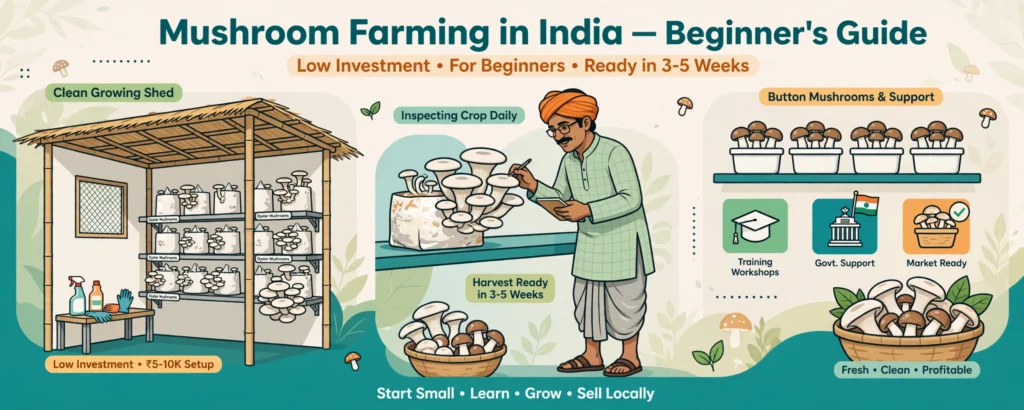
Start with oyster mushrooms, learn the process, then expand.
Step-by-step: growing oyster mushrooms
- Get training from a KVK, agricultural university, state horticulture department or ICAR-DMR, Solan.
- Prepare the room: clean, dark or dim, well-ventilated, with racks or hanging arrangements.
- Prepare the substrate: chop wheat or paddy straw, soak it in water, and pasteurise or treat it to kill unwanted fungi and bacteria.
- Spawning: mix good-quality mushroom spawn (seed) with the straw and fill it into polythene bags.
- Incubation: keep bags in a dark place for about 2–3 weeks until white mycelium covers the straw.
- Cropping: open or cut the bags, keep humidity high by spraying water, and allow some light and fresh air.
- Harvest: mushrooms appear within days. Harvest before the edges curl. You can usually get 2–3 flushes per bag.
- Pack and sell fresh, or dry them for longer shelf life.
Setup cost (small oyster unit)
Indicative costs for a small unit producing a few hundred bags per cycle:
| Item | Indicative cost (₹) |
| Room preparation (racks, ventilation, sprayers) | 10,000 – 40,000 |
| Straw for substrate | 3,000 – 10,000 |
| Spawn | 3,000 – 10,000 |
| Polythene bags, chemicals or pasteurisation setup | 3,000 – 15,000 |
| Training | 0 – 5,000 |
| Packaging and weighing scale | 2,000 – 10,000 |
| Total | roughly ₹20,000 – ₹1 lakh |
Costs vary by size, location and whether you already have a suitable room.
Simple profit example (assumed figures)
| Item | Amount |
| Bags per cycle | 300 |
| Average yield per bag (all flushes) | 1 kg |
| Total yield | 300 kg |
| Selling price (fresh, assumed) | ₹120 per kg |
| Revenue | ₹36,000 |
| Costs per cycle (straw, spawn, bags, labour, power) | ₹15,000 |
| Profit per cycle | ≈ ₹21,000 |
Actual yield and prices vary widely by season, quality and market. Start small, track your numbers, then scale up.
Government support
- MIDH (Mission for Integrated Development of Horticulture): revised 2025 guidelines provide 40% financial assistance for private mushroom units and 50% for low-cost units, subject to limits. Support also covers spawn production and compost units. Apply through your state horticulture department.
- State schemes: several states offer additional support. Ask your district horticulture office.
- Bank loans and Kisan Credit Card: for working capital. See our Kisan Credit Card guide.
- SHG and FPO support: groups can get training and credit through rural livelihood missions. See how SHGs help women start businesses.
Where to sell mushrooms
- Local vegetable vendors and mandis
- Restaurants, hotels and caterers
- Supermarkets and organic stores
- Direct to consumers via WhatsApp
- Value-added products: dried mushrooms, mushroom powder, pickles (FSSAI registration needed)
Common mistakes
- Poor hygiene, leading to contamination
- Buying low-quality spawn
- Too little ventilation or humidity
- Producing before finding buyers
- Starting too big without experience
Frequently asked questions
Which mushroom is easiest to grow in India?
Oyster mushroom is the easiest for beginners. It grows on straw and suits a wide temperature range.
How much investment does mushroom farming need?
A small oyster mushroom unit can start with roughly ₹20,000 to ₹1 lakh. Button mushroom units need more investment.
Is there a subsidy for mushroom farming?
Yes. Under MIDH revised guidelines, mushroom units can get 40% assistance, and 50% for low-cost units, subject to limits. Apply through your state horticulture department.
Where can I get mushroom farming training?
From ICAR’s Directorate of Mushroom Research (Solan), Krishi Vigyan Kendras, agricultural universities and state horticulture departments.
How long does it take to harvest oyster mushrooms?
Typically about 3–5 weeks from spawning, including incubation, with 2–3 harvests per bag.
Sources (checked 21 November 2026)
- FreshPlaza, “India’s mushroom output rises 79.4% to 319,030 tons between FY21 and FY25”, 28 October 2026 (production and MIDH assistance)
- ICAR-Directorate of Mushroom Research, Solan: dmrsolan.icar.gov.in
- National Horticulture Board / MIDH: nhb.gov.in, midh.gov.in